Buell, Pennsylvania
American RustBuell, Pennsylvania, is both a lived-in town and the remnant of a steelmaking center: its hillside streets and historic buildings endure beside a vast mill complex reclaimed by vegetation. The novel makes this contrast central to the place’s significance. The landscape records an industrial system that once organized work and family life, while the town’s diminished services and shrinking opportunities show how deeply its collapse has altered the community.
Setting and Physical Landscape
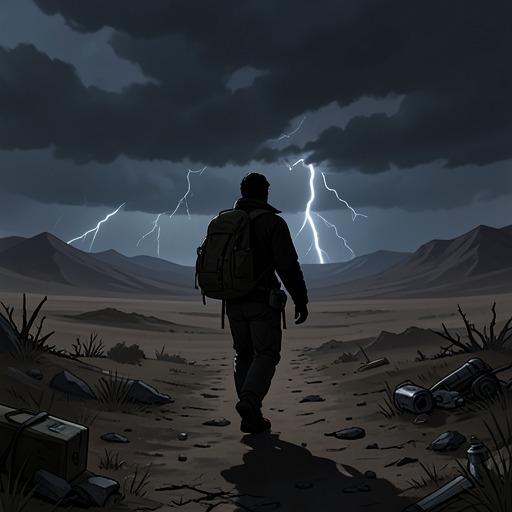
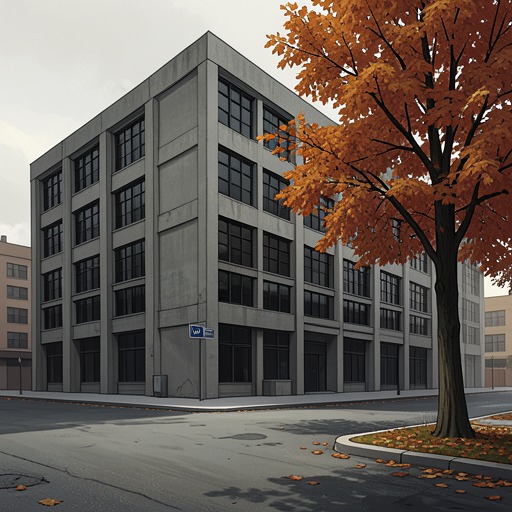
Buell lies among rolling hills, forest, and the muddy river that runs past it. From an overlook, the town appears as a concentration of houses and industrial buildings within a much larger wooded landscape. Neat rows of white houses climb the hillside; church steeples and the silver domes of an Orthodox cathedral mark the town’s built environment. Its downtown retains historic stone buildings, though many are boarded. Some blocks still receive basic attention, while others have been abandoned. The contrast is not simply between town and wilderness: within the town itself, visible signs of care sit beside neglect.
The surrounding landscape is also shaped by the routes and industries that once connected Buell to the wider region. Railroad tracks follow the river toward Pittsburgh, and the river carries barges and towboats moving coal. South of town, the road cuts through a narrow valley past vacant hamlets, abandoned service stations, and an exhausted coal mine whose broad field of tailings has become part of the terrain. These are not isolated ruins. They are traces of the extraction and transport that supported steelmaking and gave the region its economic structure.
The Mill and the Industrial Past
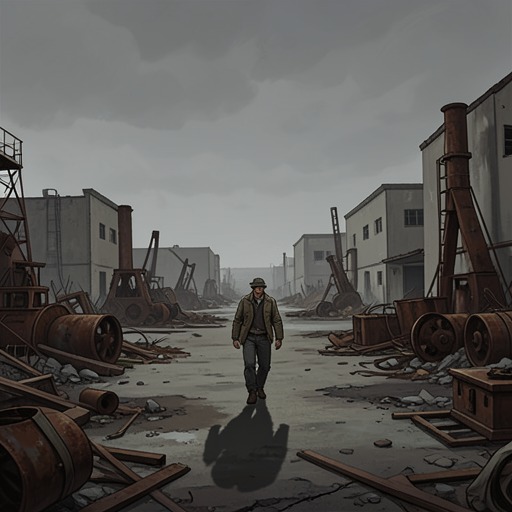
For a hundred years, the Valley was a center of steel production in the United States and, in the novel’s account, the world. Buell’s mill had once been large enough to resemble a small city. It closed in 1987 and was partly dismantled about ten years later, but the work stopped before the site could be cleared. Empty buildings, some roughly a quarter-mile long and twenty stories high, stand alongside four remaining blast furnaces and their powerhouses. Rusted pipes wind around the structures; slag cars remain on their tracks, and stacks of I-beams, T-beams, and other structural members were left behind when the dismantling ran out of money. The liability of an old steel mill, and the absence of a buyer, helped leave this industrial scale in place without its former purpose.
Vegetation and wildlife have entered the abandoned grounds. Bittersweet vine, devil’s tear thumb, and tree of heaven grow over the buildings; deer and coyote tracks cross the site, where human squatters appear only occasionally. Nature’s return does not erase the mill’s history. The remaining furnaces, rail lines, and materials make the previous industrial order legible even as the site becomes less a workplace than a ruin. The novel’s landscape holds these times together: the mill has not vanished, but neither does it provide the livelihood around which the town was built.
Work, Families, and Economic Change
The consequences of the mill’s decline appear in the history of work and household decisions. Isaac English remembers the streets at shift change, when traffic stopped for workers emerging from the billet mill coated in steel dust. In that memory, his father reaches down to lift him; it belongs to a time before an accident changed the father’s life. The recollection makes industrial employment more than a background statistic: it shaped daily rhythms and family identity, and its loss forms part of the distance between Isaac’s childhood and the present.
Grace’s experience gives another measure of how employment structured life in Buell. After high school, she came home to find that her father had bought her a car and arranged for her to start at Penn Steel. She worked on the rolling line, met Virgil there, and became pregnant. She began college, first while pregnant and then while caring for a baby, but layoffs ended her studies. Virgil survived several rounds of cuts before losing his job; his seniority was not enough to protect him. Later, job training in robotics led to no work, and a barge-making plant where he found employment also closed. Grace’s history shows choices narrowing through circumstances that extend beyond any one household: schooling, marriage, and plans for a future were repeatedly reshaped by the availability of local work.
The mill closures also spread hardship through families and neighboring towns. Grace recalls waiting for the mills to reopen as layoffs continued across the Valley, while employment opportunities dwindled. Her account of a relative losing his home and family amid financial pressure conveys the severity of the period without making one household’s misfortune the whole explanation. Buell and its surroundings are presented as a place where industrial collapse affected housing, income, and the ability to imagine starting over. Some workers left for distant states, sometimes living several to a motel room and sending money home; many returned. Remaining near familiar people could seem preferable to leaving, even when local prospects were poor.
Public Strain and Regional Consequences
The town’s economic contraction is part of a wider regional crisis. Since Isaac and Billy Poe were born, the area had lost 150,000 jobs. Many towns could no longer afford basic services, and some had lost their police departments. The novel links the former steel industry to a network of smaller businesses, including tool-and-die work, specialty coating, and mining equipment. As mills shut down, the industries that depended on them also weakened. Buell’s condition therefore reflects the breakdown of an interconnected regional economy, not only the closure of one factory.
The pressure remains visible in local government and public safety. The Valley’s population is growing again, but incomes and municipal budgets continue to fall, while infrastructure has received no investment for decades. Towns face serious problems with limited resources; some nearby communities are described as already beyond recovery. The prospect of Buell’s police department losing its budget and merging with a regional force further shows how economic decline reaches public institutions. At the same time, the novel resists treating police as a solution to unemployment and social instability: the department cannot by itself restore stable work or reverse the wider collapse.
Narrative Significance
Buell is the setting through which the novel makes economic change concrete. A closed mill, a boarded downtown, an abandoned mine, a shrinking job market, and strained public budgets belong to different scales of experience, but they meet in the lives of residents. The town’s history is carried both by massive remains, such as its blast furnaces, and by ordinary memories of shift change, lost schooling, layoffs, and decisions about whether to leave.
The place also gives movement through the story a particular meaning. Railroad tracks run alongside the river and offer routes toward Pittsburgh and beyond, while the wooded hills and industrial grounds surround the people who remain. Buell is neither a sealed-off community nor a setting the characters can simply discard: it is connected to wider systems of labor and migration, yet its landscapes and relationships retain their force. The town’s enduring stone structures and the encroaching growth at the mill site hold the novel’s central contrast in view: industrial history persists physically even as the economic order that made it livable falls away.